
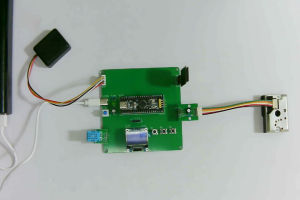

设计说明书
总字数:15000+
摘 要
蓄电池室运行状态直接关联电力系统稳定,对其环境参数精准监测与异常预警需求迫切。传统监测方式依赖人工巡检,存在实时性差、预警滞后、参数管控低效等缺陷。设计一款基于STM32F103C8T6单片机的蓄电池室辅助状态感知装置,实现环境参数实时采集、阈值管控、异常预警及远程交互,具有重要工程实用价值。
本装置以STM32F103C8T6单片机为控制核心。硬件上集成DHT11温湿度检测模块、GP2Y1014AU PM2.5检测模块、OLED液晶屏、CN-TTS语音模块、ESP8266-12F WIFI模块及按键模块,构建完整感知、显示、预警与传输回路。完成蓄电池室温湿度、粉尘浓度参数实时采集,通过按键实现本地阈值设置,依托OLED屏完成参数可视化呈现,借助语音模块实现异常预警播报,通过WIFI模块达成数据远程传输与阈值远程配置。软件上采用模块化编程架构,实现传感器数据精准采集、阈值对比判断、语音播报触发、屏幕数据刷新、WIFI数据交互及本地与远程阈值同步更新等功能。测试结果表明,装置可实时稳定采集温湿度、PM2.5浓度参数,采集精度满足蓄电池室监测需求;本地与手机端远程阈值设置灵活同步,参数超出阈值时CN-TTS模块每10秒自动播报预警,OLED屏清晰显示当前参数及对应阈值,WIFI模块数据传输稳定,远程交互响应及时。
该装置实现蓄电池室环境参数的智能化监测、可视化呈现、多级预警及远程管控。具备操作便捷、响应精准、运行可靠的特点,可有效弥补传统人工巡检不足,提升蓄电池室运行状态监测的实时性与智能化水平,保障蓄电池安全稳定运行,符合电力系统辅助监测设备发展需求,具有良好的实用价值与推广前景。
【关键词】STM32F103C8T6 蓄电池室 状态感知 远程管控 语音预警 温湿度检测 PM2.5检测
Abstract
The operational status of battery rooms directly affects the stability of power systems, making it urgent to accurately monitor environmental parameters and implement timely anomaly warnings. Traditional monitoring methods rely on manual inspections, which suffer from poor real-time performance, delayed alerts, and inefficient parameter management. To address these issues, this study designs an auxiliary status perception device for battery rooms based on the STM32F103C8T6 microcontroller, enabling real-time data acquisition, threshold-based control, anomaly warning, and remote interaction—offering significant engineering application value.
The proposed device adopts the STM32F103C8T6 microcontroller as its core controller. In terms of hardware, it integrates a DHT11 temperature and humidity sensor module, a GP2Y1014AU PM2.5 sensor module, an OLED display screen, a CN-TTS speech synthesis module, an ESP8266-12F Wi-Fi module, and a keypad module, forming a complete system for sensing, visualization, alerting, and data transmission. The device achieves real-time acquisition of temperature, humidity, and dust concentration within battery rooms. Local threshold settings are configurable via the keypad, while the OLED screen provides clear visual feedback of measured parameters. When anomalies occur, the speech module delivers voice alerts, and the Wi-Fi module enables remote data transmission and remote threshold configuration.
On the software side, a modular programming architecture is implemented to ensure precise sensor data collection, threshold comparison, voice alert triggering, dynamic screen updates, Wi-Fi communication, and synchronized threshold updates between local and remote interfaces. Experimental results demonstrate that the device can stably and accurately collect temperature, humidity, and PM2.5 concentration data with sufficient precision to meet battery room monitoring requirements. Both local and smartphone-based remote threshold configurations are flexibly synchronized. When any parameter exceeds its preset limit, the CN-TTS module automatically issues voice warnings every 10 seconds, while the OLED screen clearly displays current readings and corresponding thresholds. The Wi-Fi module ensures stable data transmission and responsive remote interaction.
This device realizes intelligent monitoring, visual presentation, multi-level alerting, and remote management of environmental conditions in battery rooms. Featuring user-friendly operation, accurate response, and reliable performance, it effectively overcomes the limitations of traditional manual inspection methods. It enhances the real-time capability and intelligence level of battery room monitoring, ensuring safe and stable operation of batteries. Aligned with the development needs of auxiliary monitoring equipment in power systems, the device demonstrates strong practical value and broad prospects for widespread application.
Keywords: STM32F103C8T6, Battery Room, Status Perception, Remote Management, Voice Alert, Temperature and Humidity Detection, PM2.5 Detection
目 录
Abstract
1 绪论
1.1 研究背景及意义
1.2 国内外研究现状
1.2.1 国内研究现状
1.2.2 国外研究现状
1.3 主要内容
2 系统设计方案
2.1 整体设计架构
2.2 主要模块方案选择
2.2.1 主控模块方案选择
2.2.2 温湿度检测模块方案选择
2.2.3 粉尘浓度检测模块方案选择
2.2.4 无线通信模块方案选择
2.2.5 语音预警模块方案选择
2.2.6 显示模块方案选择
2.2.7 按键模块方案选择
3 系统硬件设计
3.1 STM32F103C8T6最小系统
3.2 感知模块硬件设计
3.2.1 DHT11温湿度检测模块
3.2.2 GP2Y1014AU PM2.5检测模块
3.3 按键模块硬件设计
3.4 预警模块硬件设计
3.5 显示模块硬件设计
3.6 通信模块硬件设计
4 系统软件设计
4.1 编程软件介绍
4.2 系统主流程设计
4.3 独立按键
4.4 温湿度检测模块子流程
4.5 GP2Y10模块子流通
4.6 WiFi模块子流程设计
5 实物制作及功能测试
5.1 系统实物制作
5.2 系统功能测试
5.2.1 温湿度采集功能测试
5.2.2 粉尘浓度采集功能测试
5.2.3 阈值设置功能测试
5.2.4 语音预警功能测试
5.2.5 OLED显示功能测试
5.2.6 WIFI远程交互功能测试
5.2.7 系统稳定性测试
结论
参考文献
致 谢
附 录
附录一:原理图
附录二:PCB
附录三:主程序
购买后可查看具体内容!