
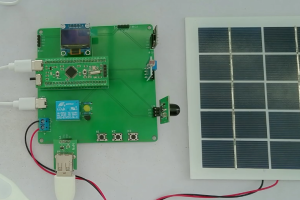

设计说明书
总字数:29000+
基于单片机的太阳能路灯智能控制系统
摘要
传统太阳能路灯多采用固定模式照明,存在光照适配性差、电能利用率低、照明模式单一、管控不便等问题,难以适配户外复杂光照与人员活动场景的照明需求,无法实现供电模式与照明亮度的智能化动态调节。本文设计一款基于STM32F103C8T6单片机的太阳能路灯智能控制系统,实现路灯照明与供电方式的自动化、智能化管控。系统集成环境光照检测、人体红外感应、亮度智能调节、本地参数设置与显示、蓝牙无线远程控制等核心功能。通过5516光照检测模块实时采集环境光照强度数据,依据预设光照阈值自动切换供电模式,光照强度高于设定最小值时采用太阳能板供电,低于最小值时自动切换为市电供电。依托D203S人体热释电传感器感知现场人员活动状态,结合光照阈值分级调控路灯亮度,光照强度低于设定最大值且无人活动时,路灯保持低亮度节能照明;光照强度低于设定最大值且检测到人员活动时,路灯切换为高亮度照明;光照强度高于设定最大值时路灯自动熄灭。系统配备独立按键,支持用户自定义设置光照阈值、手动控制路灯开关状态,搭配OLED显示屏实时同步显示环境光照强度、人体感应状态、路灯运行开关状态等核心参数。同时通过ECB02蓝牙模块搭建手机端无线通信链路,可将设备运行数据实时传输至移动端,用户可远程操控路灯开关、切换供电模式,依托继电器模块完成供电方式的模拟切换。本系统有效解决了传统太阳能路灯智能化程度低、能耗浪费、管控滞后的痛点,实现了光照自适应供电切换、人体感应智能调光、本地触控调试与移动端远程管控的一体化功能,大幅提升了太阳能路灯的节能效果与运维便捷性,适配户外道路、园区等多种照明场景,具备较高的实用价值与推广应用前景。
关键词:STM32单片机;太阳能路灯;智能控制;光照检测;蓝牙远程管控
Traditional solar street lights mostly adopt fixed lighting modes, which have problems such as poor light adaptability, low power utilization efficiency and single lighting mode, and are inconvenient to manage and control. They cannot adapt to the lighting requirements of complex outdoor light and personnel activity scenarios, and fail to realize the intelligent dynamic adjustment of power supply mode and lighting brightness. This paper designs an intelligent control system for solar street lights based on STM32F103C8T6 microcontroller to realize the automatic and intelligent management and control of street light lighting and power supply modes. The system integrates core functions including ambient light detection, human body infrared induction, intelligent brightness adjustment, local parameter setting and display, and Bluetooth wireless remote control. The 5516 light detection module is used to collect real-time ambient light intensity data, and automatically switch the power supply mode according to the preset light threshold. When the light intensity is higher than the set minimum value, the solar panel is used for power supply; when it is lower than the minimum value, the power supply is automatically switched to municipal power. The D203S human body pyroelectric sensor is adopted to sense the on-site personnel activity status, and the street light brightness is graded and adjusted combined with the light threshold. When the light intensity is lower than the set maximum value and no personnel are active, the street light maintains low-brightness energy-saving lighting; when the light intensity is lower than the set maximum value and personnel activities are detected, the street light switches to high-brightness lighting; when the light intensity is higher than the set maximum value, the street light automatically turns off. Equipped with independent keys, the system supports users to customize and set light thresholds and manually control the switch state of street lights, and is matched with an OLED display screen to synchronously and real-time display core parameters such as ambient light intensity, human body induction state, and street light operation switch state. At the same time, the ECB02 Bluetooth module builds a wireless communication link with the mobile terminal, which can transmit real-time equipment operation data to the mobile terminal. Users can remotely control the street light switch and switch the power supply mode, and complete the analog switching of power supply modes relying on the relay module. This system effectively solves the pain points of low intelligence, energy waste and lagging management and control of traditional solar street lights, and realizes the integrated functions of light self-adaptive power supply switching, human body induction intelligent dimming, local touch debugging and mobile terminal remote management and control. It greatly improves the energy-saving effect and operation and maintenance convenience of solar street lights, adapts to a variety of lighting scenarios such as outdoor roads and parks, and has high practical value and promotion and application prospects.
Keywords:STM32 Microcontroller; Solar Street Light; Intelligent Control; Light Detection; Bluetooth Remote Control
购买后可查看具体内容!